
The Opportunity of Being Human in the Age of AI

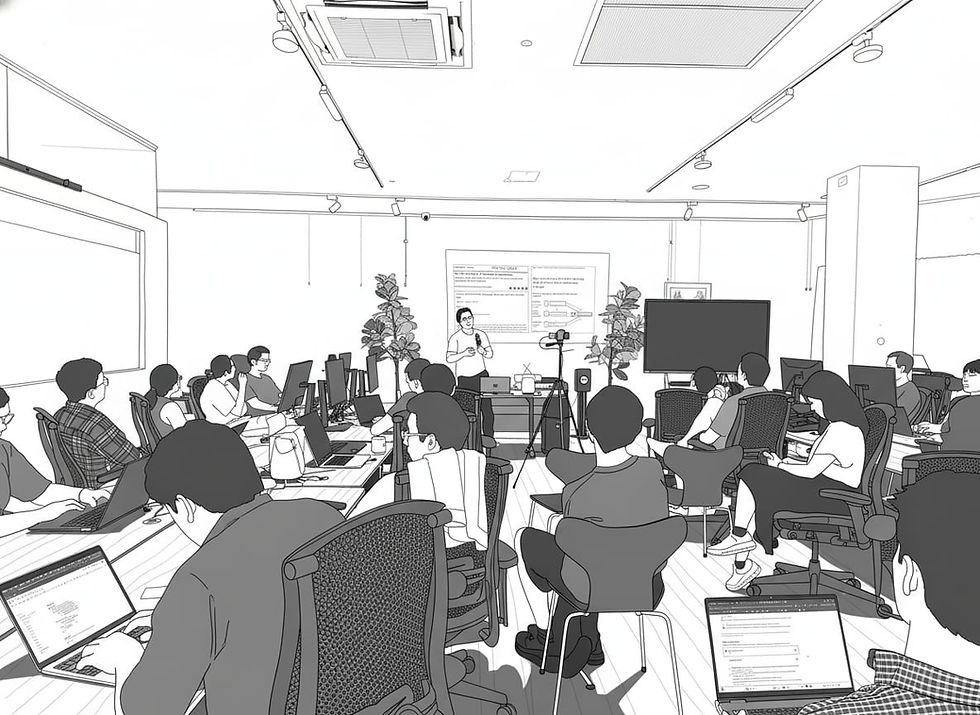
Russell's talk at Co-work Fridays @ SQ Collective — The Stage
Here's a question worth sitting with: when was the last time a platform actually saw you? Not just your job title. Not the interests you ticked at signup. Not the aesthetic you've curated on Instagram. You. The full, contradictory, multifaceted person who contains, as Russell put it, a universe.
But this is not a mistake. It has alway been a design decision. And it is one that's starting to cost us.
The Box Problem
Every major social platform runs on the same architecture: put people in boxes, sell the boxes to advertisers.
Linkedin is your work box. Tinder is your dating box. Facebook is your personal life box. X is your opinions box. Each one captures a slice of who you are and treats it as the whole.
The problem isn't that these platforms are bad at what they do. Most of them are technically excellent at sorting people by declared category. The problem is that humans don't actually work that way.
Russell made this point by introducing himself through a list: cybersecurity researcher, private investigator, competitive powerlifter (272kg deadlift), church-goer, theology reader, volunteer. Not one of those identities cancels out the others. They're all real. They coexist.
But try putting that into a profile. Try finding the platform that sees all of it.
"They want you in a box," he said. "A discrete variable. A category they can sell."
What Gets Lost
When platforms flatten who you are, they also flatten who you can find. Your network becomes whoever shares your professional category, your dating preference, your demographic. The serendipitous connection, the one between the ex-special-forces renovator and the Japanese architecture historian, or the tea ceremony teacher and the community startup founder, never happens. The platforms weren't built to see it.
Research on social capital consistently shows that weak ties drive most meaningful opportunity connections across contexts, not within them. The person who knows someone you'd never think to look for. The overlap you didn't know you had. Platforms built on discrete categories kill weak ties. They optimize for the obvious match, not the surprising one.
And the surprising ones are where the interesting stuff happens.
Ujong: What It Looks Like to Actually See Someone
Ujong is an LLM-powered matchmaking tool. The mechanic is a 20-25 minute deep questionnaire: not a profile, not a form, but something closer to an intake conversation. Questions designed to surface the complexity of a person: what they care about across different contexts, what they're working on, what kind of connections they actually want.
The LLM doesn't just store that. It uses it to make introductions, with a personal, AI-generated message that explains the why of the connection, not just the what.
The result: ~90% conversion on introductions. Meaning: when two people receive a Ujong intro, nine out of ten times, they actually meet.
That number deserves attention. Email intro conversion in the real world sits somewhere between "maybe" and "sorry I missed this." The reason Ujong's rate is different isn't technology, it's that both people feel seen before they've spoken. The intro demonstrates that someone (or something) understood them well enough to know this specific connection matters.
Research in behavioral economics shows that perceived relevance is the single biggest driver of whether people act on a recommendation. Generic doesn't convert. Specific reasons grounded in real understanding does.
50+ people have completed the Ujong questionnaire. The feedback loop is already showing what better matching looks like.
From 1-to-1 to 1-to-X: Infrastructure Thinking
The matchmaking tool is the proof of concept. The bigger vision is something Russell calls "one-to-X" broadcasting. The idea: you shouldn't need a full event management stack to rally ten people around a niche interest. If you're into rare frog species in Singapore, you should be able to surface your people and propose a meetup, without building a Luma event, managing an invite list, and running a follow-up sequence.
To Russell, this is social infrastructure and not social media.
The distinction matters. Social media is designed to capture attention and keep people on the platform. Social infrastructure is designed to facilitate real-world coordination and then get out of the way. The internet was built on infrastructure logic: email, protocols, shared standards. Somewhere along the way, platforms replaced infrastructure thinking with engagement thinking. We're still living with the consequences.
The VC Said No.
Russell got a clean rejection from a VC: "CAC too high, Meta did it first."
Both objections are technically defensible. Getting people to complete a 25-minute questionnaire is expensive. Meta has tried versions of social graph expansion before.
But both objections also assume the current platform paradigm is the right frame. CAC matters if you're competing for the same users as Meta. If you're building for the people Meta can't see—the genuinely complex, multifaceted humans who don't fit discrete categories—then you're not in the same competition.
Russell's thesis is that this population is growing. As AI reshapes how we work and relate, the people who don't fit the standard professional/social profile categories are becoming more common, not less. It's also for these people in his life:
His friend's mother — who couldn't afford movers when relocating from Simpang to Yishun. The only help available was Russell and her sister.
Elderly in nursing homes — the old folks who get "robot karaoke interfaces" in their nursing homes instead of real human connection.
A growing proportion of society — for those in cosmopolitan cities with "a growing proportion of people in our society" who need social digital infrastructure but are locked out by paywalls, event tickets, and economic barriers.
High-performing expats/workers in commercial districts — people working in places like One North who "don't want to go all the way to town for an event after work" and end up with no social life, even though the person standing right beside them in the lift could potentially become their best friend
Social enterprise workers — people in incubators like Better Down the Street who could cross-collaborate but lack the infrastructure to discover each other
Being Human in the Age of AI
In a world obsessed with optimizing every minute, Russell poses a question that cuts straight to the bone:
"What's the point of efficiency and productivity if we don't have people to spend time with?"
It's a deceptively simple line. Because for all the tools we're building to move faster, think faster, and do more, we're quietly hollowing out the thing that made any of it worth doing in the first place: genuine human connection.
Russell isn't anti-technology. He's building with it. But his bet is that the most meaningful thing tech can do right now isn't to replace human effort: it's to create the conditions for people to actually show up for each other again. Not through algorithms that flatten us into categories, but through systems that honor the messy, beautiful complexity of who we really are.
What to Take From This
Whether you're building a product, a community, or just thinking about how you show up online: Russell's framework has practical implications.
If you're building a product that involves people:
Ask what slice of humanity your model captures. What gets flattened? Who does your system fail to see? Sometimes the most important question in product design isn't "what do users want" but "what about users are we currently ignoring?"
If you're thinking about community:
Infrastructure thinking changes what you build. Instead of asking how to keep people engaged on your platform, ask what coordination problems your community actually has—and build the minimum infrastructure to solve them. Then get out of the way.
If you're thinking about your own connections:
The weak tie literature is consistent: the people most likely to change your trajectory are the ones in contexts you don't usually inhabit. The crossover between your powerlifting self and your theology self. The overlap nobody has thought to introduce yet.
Learn more about Ujong and what Russell is building. These conversations—about platforms, infrastructure, human complexity—are exactly what Co-work Fridays at SQ Collective is for.
Missed out last week?
Don't worry, these conversations happen every Friday at SQ Collective.
Usually over laptops. Sometimes over pizza.
You're welcome to join the next one.


Comments