
The Human Moat: Differentiation in the Age of AI

Haodan's explorations into this topic started with a question from a lead data scientist inside SAP, someone who should have had the least fear. He asked the visiting CAIO, “how can we stay on top in the age of AI?”
That question from someone “working at the frontier” surprised Hao Dan, Lead Product Manager for one of SAP’s most successful AI products. In this week's session of The Stage, Haodan shared her thoughts on what she thinks is the recipe for differentiation in the age of AI, and the answer is not more AI.
The Prerequisite is Digitalization
Haodan's core idea is that AI’s prerequisite is digitalization. To have an impact, AI must convert the world into numbers. That conversion reveals its fundamental limitation.
She points to the Apple Vision Pro. The first time, it’s impressive. You’re suddenly by a lake. The second time? “I was very bored.”
An experience can be simulated, but it can't replace the real thing. The feeling of being by a real lake, the energy of a live concert, these things cannot be fully put into a digital form. They are intangible.
The human moat is in the things that can’t be digitized. It's the real tear versus the chemically identical drop of water. One has a story. The other is just data.
Who, Not What
When creation becomes cheap, the ‘who’ behind the work becomes the differentiator. She shares an anecdote on the Dafen Oil Painting Village in Shenzhen, a place famed for the production of imitations of famous paintings. To her, none of the imitations touched her.
The same difference between a real tear and a synthetic tear that is 100% composed of the same chemical components. The narrative, the essence, the "who" behind creations is what differentiates in the age of AI.
In the age of AI, anyone can now generate a Van Gogh-style painting of a cat, so the base value of the creation shifts.
An audience member argued that the AI-generated cat in Van Gogh’s style still has creative value. It’s not worthless.
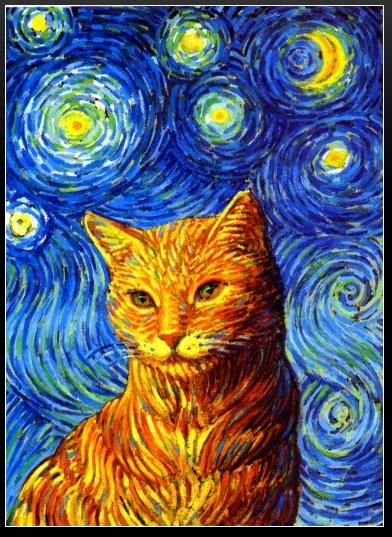
Haodan agreed but reframed the point. The original Van Gogh is the most valuable because he was the first, the originator. “The person itself defines the word or become an objective to describe the thing and that's where you're differentiated.”
The value is in the 'who': the story, the struggle, the unique vision of the artist. As the entry bar for the 'what' gets lower, the value of an authentic 'who' goes up.
There is an interesting fork in the road here worth mulling over in future conversations: if a touching piece of creation is enlivened by the authentic narrative of the human creator, and that narrative is a synthesis of his/her unique experiences over time, will AI be able to recreate it? Given that it is very possible for AI to create genuinely good quality snapshots of narratives, will weaving together a few of these snapshots shouldn't be a problem, right?
The Anchor of Vision
The idea of the ‘who’ scales from an individual to a company, where the ‘who’ becomes its vision.
Haodan used SAP’s own success as an example. Their AI document processing product, with 30,000 customers, has evolved through multiple tech waves over more than five years. There has always been talk about how SAP will become irrelevant with each wave, and yet, each passing wave amplified the adoption of the product amongst SAP's customers.
Haodan reckons that the resilience of SAP was because it had an anchor and a clear understanding of "who" she was.
SAP's vision has always been to help the world run better. The company was founded on the observation that businesses needed software that could process data and transactions in real-time. Hasso Plattner, one of the co-founders of the firm, famously spent his days sitting side-by-side with clients at their offices, learning the intricate details of financial accounting to build a system that exactly met their needs.
SAP was clear on the problem they were solving - it is not a sexy problem, but a meaningful one nonetheless. The technology, whether it was narrow AI, LLMs, or agents, was just the tool. The need was the constant. The who was constant.
This was the key point for me. A company’s vision is its anchor. If you’re anchored to a technology, you’ll be thrown around. If you’re anchored to a human need, you can use new technologies as they come.
The Journey Inside
For an individual or a founder, Haodan argues the search for a differentiator is an inward journey.
"I feel that at least this group here, who know the technology and know how to leverage the technologies to create differentiation for the business, knowing who and what you stand for will create an immense value... It allows you to, instead of just running around, joining the competition and eventually become commoditized, you follow your own heart and calling. If you find this, you won't really be replaced in my opinion."
Successful founders have their own stories. They are connected to a problem that matters deeply to them, which comes from self-knowledge instead of market research.
The starting point is looking inside to find the intangible values and experiences that make you, you.
So the conclusion of how to differentiate in the age of AI is not, more AI, but something deeply human. It's a reconnection with the authenticity within.
These are the kinds of conversations we have at SQ Collective. Builders wrestling with the real questions. Not just about the tech, but about what it means to build something that lasts.
Missed out last week? Don't worry, these conversations happen every Friday at SQ Collective.
Usually over laptops. Sometimes over pizza.
You're welcome to join the next one.


Comments